
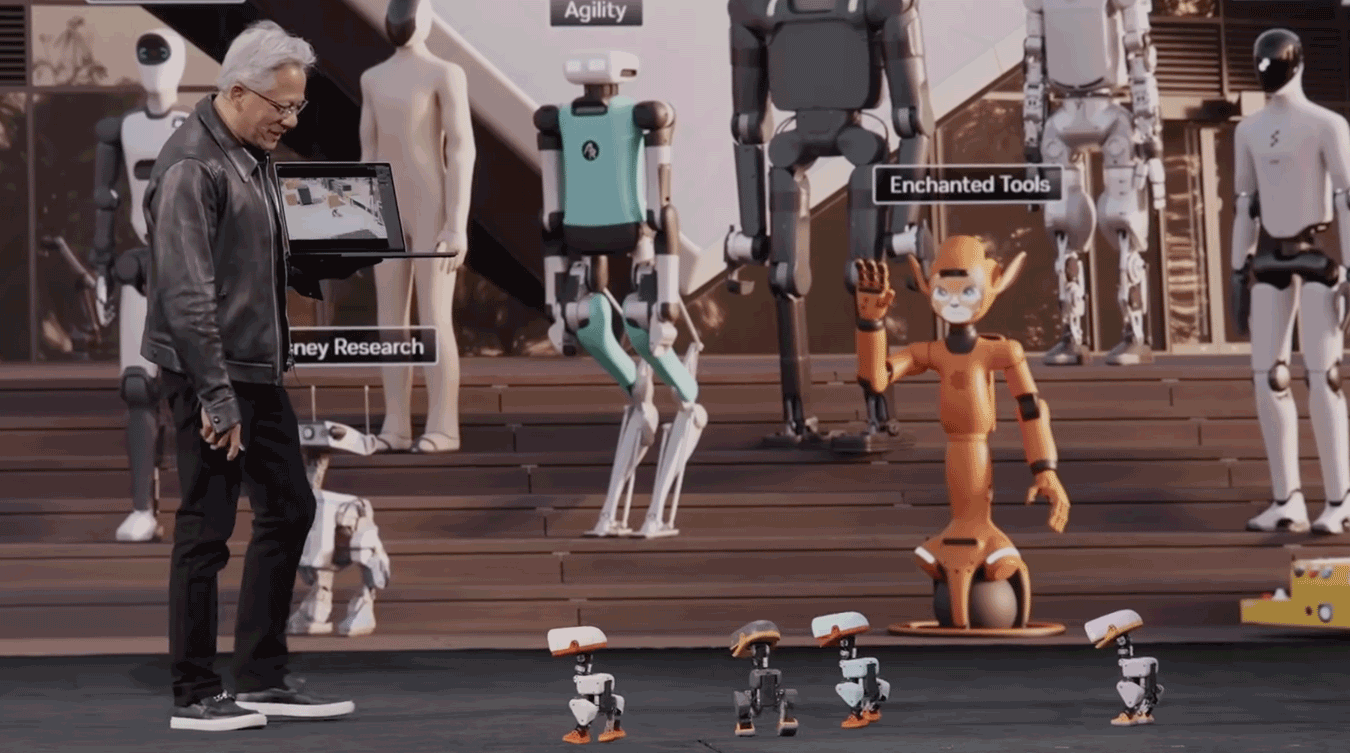
At NVIDIA’s recent GTC Berlin conference, CEO Jensen Huang shared the stage with four 10-inch, bipedal robotic ducks. Developed by open-source AI platform Hugging Face and its French robotics subsidiary, Pollen Robotics, the “Microduck” is a 25-centimeter-tall open-source robot that costs just $399.
The market response was immediate and overwhelming. Hugging Face reportedly secured $2.6 million in Microduck orders within the first 24 hours of launch.
The Context: Not Just a Desktop Toy
While the robots stole the show by nailing backflips and somersaults onstage, they represent a massive leap forward in modular robotics economics.
The Microduck operates as a physical vessel for NVIDIA’s Nemotron 3.5 Bolt, a Vision-Language Model (VLM) with 74 billion parameters. In the past, making a bipedal robot walk required intensely complex, rigid math and coding. Instead, the Microduck’s brain was trained using reinforcement learning inside NVIDIA’s Isaac Sim environment. Thousands of simulated ducks ran virtual obstacle courses, falling down and correcting their policies based on physics feedback, before the final, highly resilient training file was loaded onto the $399 physical hardware.
Real-Time Environmental Comprehension
The true power of the Microduck lies in its spatial awareness. In physical testing environments, the robot’s onboard Vision-Language Model (VLM) processes its surroundings with remarkable speed. It instantly identifies varied terrains—from elevated wood steps and sloped ramps to textured rubber mats. This is not pre-programmed, rigid movement. It is dynamic environmental comprehension. By mapping these specific obstacles on the fly, the robot organically adjusts its gait and balance. This real-time processing demonstrates the immense potential of combining lightweight, affordable hardware with heavy-hitting, open-source AI models.
The Impact for Founders
For early-stage founders and developers, the Microduck shatters the barrier to entry for building physical AI agents. You no longer need $50,000 to prototype an autonomous, vision-capable robot.
By combining a cheap, open-source chassis with hyper-advanced simulation training (NVIDIA RTX Spark and Isaac Lab), hardware startups can now focus entirely on building high-value agentic software and RL policies, rather than burning runway figuring out how to make basic actuators balance. This $399 duck is the ultimate proof of concept that physical robotics is finally experiencing its “app store” moment.